Driving in Hua Hin: A Complete Guide for Tourists
Thailand drives on the LEFT — and that one fact reshapes every decision you make behind the wheel. This guide covers the rules that actually matter in Hua Hin, from Highway 4's U-turn logic to which roads to Kaeng Krachan need a 4WD.
Compare Car Rental DealsSearch & Compare Car Rental Deals
Free cancellation on most vehicles
Driving on the Left: The #1 Adjustment
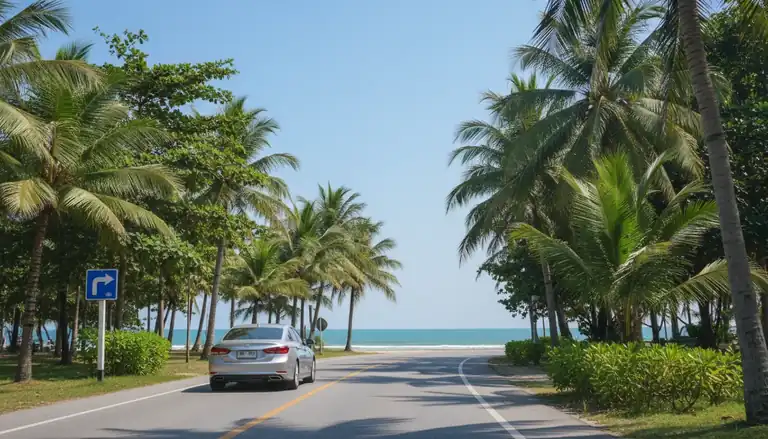
Thailand uses left-hand traffic, and rental cars are right-hand drive — the steering wheel is on the right side of the car. If you are coming from the US, continental Europe, or the Middle East, your brain will try to default to the right side of the road at every unguarded moment. The critical thing to know is that first-day mistakes rarely happen on busy highways. They happen on quiet side streets, on parking lot exits, and in the seconds after turning onto a secondary road when your autopilot kicks in.
A second issue specific to right-hand-drive cars is spatial drift. Because you are sitting on the right side of the cabin, the natural instinct to center yourself in the car will push the vehicle toward the left lane edge — and in Hua Hin that means toward the gutter, parked scooters, and cyclists. Experienced drivers in Thailand recommend visually anchoring the lower-right corner of the windshield to the lane center line as a reference until the new geometry becomes intuitive.
Drive on the LEFT. Overtake on the RIGHT. In a right-hand-drive car, the driver sits closest to the center of the road — not the kerb. Keep your passenger near the kerb and you are positioned correctly.
Three practical habits that make the first day easier: take an automatic rather than a manual so you have one fewer mechanical task to manage; plan your first drive in daylight on a straightforward route; and ask a passenger to call out "stay left" after every turn and parking lot exit until it feels natural. Resist the urge to do a rural or night drive on day one — Hua Hin's coastal grid is a far better place to recalibrate than a mountain road toward Kaeng Krachan. See our guide to Hua Hin day trips once you are comfortable with the basics.
Thai Driving Rules That Actually Matter
The most common mistake tourists make is assuming a flat national speed limit applies everywhere. Thailand's post-reform limits allow up to 80 km/h in community areas, 90 km/h on open rural roads, and 120 km/h on motorways and designated highway sections. In practice, what matters is the sign in front of you. The urban stretch of Phetkasem Road through central Hua Hin is posted well below the national maximum, and police enforcement near schools, markets, and U-turn pockets is consistent. Drive to the sign, not to a memorized number.
Key Laws at a Glance
| Rule | What the law says | Practical note |
|---|---|---|
| Speed — community area | Up to 80 km/h | Obey posted signs; central Hua Hin is lower |
| Speed — rural/open road | Up to 90 km/h | Sign-dependent; reduce in rain |
| Speed — motorway | Up to 120 km/h | Applies to toll motorways, not Highway 4 |
| Blood alcohol (BAC) | 0.05% standard; 0.02% young/provisional drivers | Checkpoints run nightly 22:00–04:00 on Highway 4 |
| Seatbelts | Mandatory all seats (enforced since Sep 2022) | Rear passengers included; fines apply |
| Child restraint | Required for children under 6 years old | Rental companies may not supply automatically — request in advance |
| Mobile phone | Hands-free only (law since Oct 2022) | Applies even when stopped at a red light |
The BAC limit deserves emphasis. Thailand's 0.05% standard has zero tolerance exceptions for young or provisional licence holders, who face a 0.02% limit. Police sobriety checkpoints on the Hua Hin–Cha Am corridor run routinely, particularly on holiday weekends, and refusing a breathalyser carries the same legal consequence as failing one. DUI in Thailand is a criminal offence, not an administrative one, with penalties up to 20,000 THB and potential imprisonment.
On child seats: the law requires an appropriate restraint for children under 6 (or under 135 cm). Do not assume your rental company will have one available without a prior request, especially in peak season. Book the seat at the same time as the car.
Your Licence and the IDP
To drive legally in Thailand as a tourist, you need three documents in the car at all times: your International Driving Permit (IDP), your original home-country driving licence, and your passport. The IDP is a translation document — it has no legal standing on its own. Police checkpoints specifically target foreign drivers to verify all three.
The IDP format is not universal. While Thailand recognises both the 1949 Geneva Convention and the 1968 Vienna Convention formats, the correct version for your nationality depends on which your home authority issues for Thailand. For example, the UK government's official guidance specifies the 1968 IDP for Thailand — not 1949. Check the official guidance for your country before you travel; obtaining the wrong format is not a technicality you can resolve at a checkpoint.
Missing or incorrect documents do not just create a fine — they can void your rental car insurance claim entirely. Verify your IDP format with your national motoring authority before travelling.
If you are planning to pick up a rental at the start of a longer Thailand trip, you can compare Hua Hin car rental deals and arrange the booking well ahead — this also gives you time to confirm your IDP is in order before you land.
Highway 4 and the U-Turn Logic
Phetkasem Road — Highway 4 — is Hua Hin's spine. Everything from the train station to BluPort mall to the southern beach areas runs off it, and it handles both local city traffic and long-haul movement between Bangkok and the south. Understanding how this road works will save you considerable frustration.
The key difference from most Western road layouts is the U-turn system. Instead of turning directly across a divided highway, Thai road design channels cross-traffic through designated U-turn pockets cut into the median. In practice this means: if you want to reach somewhere on the opposite side of Highway 4, you drive past it, find the next U-turn opening, turn around, and come back on the correct side. Navigation apps show this correctly, but it feels counterintuitive on the first day. Do not try to improvise a cross-median left turn — there is usually no safe point to do so and vehicles behind you will not be expecting it.
On traffic signals: do not assume a free left turn on red as a default. In Thailand, turning left on red is only permitted where a specific sign explicitly allows it. At most intersections on Highway 4, you wait for green. When in doubt, wait.
On Highway 4, cross-traffic uses U-turn pockets — not direct left turns. If your destination is on the opposite side of the road, drive past it, find the next U-turn opening in the median, turn around, and come back on the correct side. Do not improvise a cross-median left turn. Also: free left on red is not a default in Thailand — wait for green unless a sign explicitly permits otherwise.
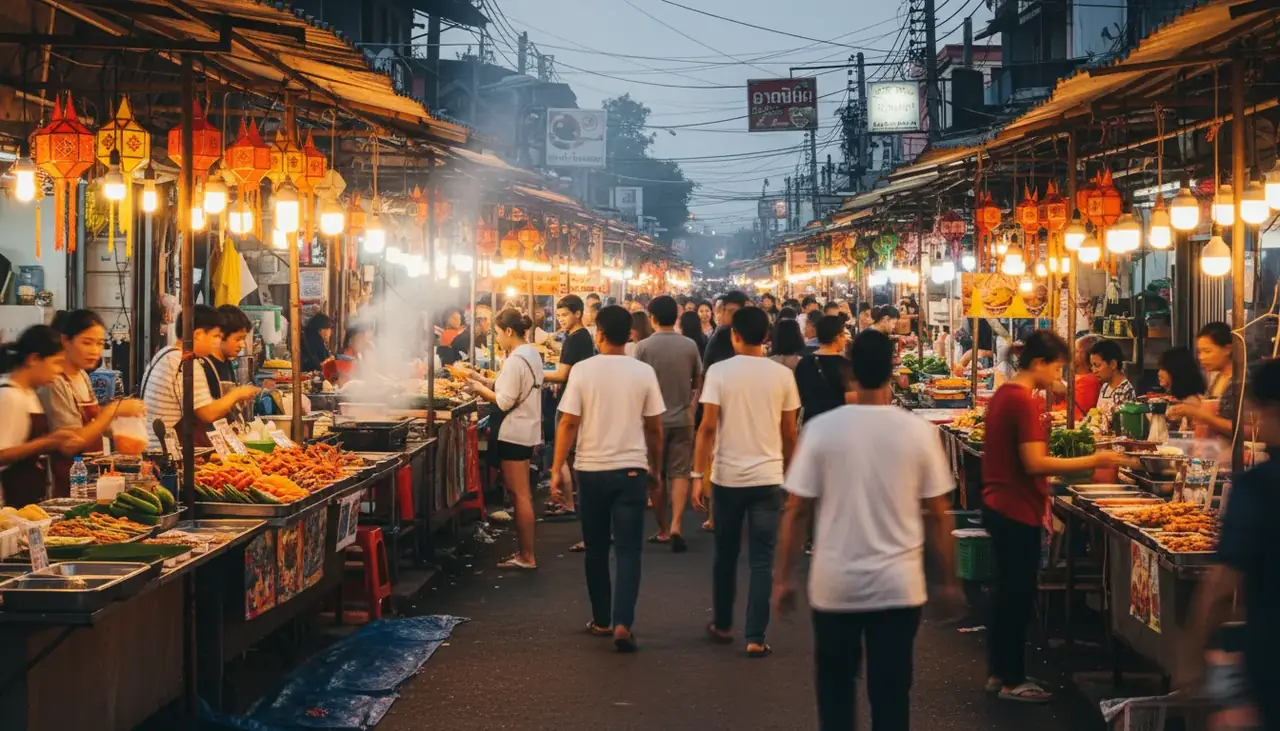
After 18:30, the streets around the night market area — Chat Chai, Dechanuchit, and Naresdamri — become significantly more congested. The mix of food stalls, pedestrians, and parked vehicles on these narrow soi makes driving through the core of Hua Hin's evening market zone more trouble than it is worth. Better strategy: park near Highway 4 or at a mall, then walk in.
Roads to the Attractions
Most of Hua Hin's major day-trip destinations are reachable in a standard rental sedan, but a few routes change character significantly once you leave the sealed main roads. Here is what to expect for each direction.
| Destination | Distance from Hua Hin | Drive time | Car type needed |
|---|---|---|---|
| Monsoon Valley Vineyard | ~36 km | 40–45 min | Standard sedan fine on sealed road |
| Kaeng Krachan NP headquarters | 65–75 km | 1–1.25 hrs | Sedan to HQ; 4WD only for Phanoen Thung climb |
| Pala-U Waterfall | 60–70 km | 50–90 min | Sedan fine; more care needed in wet season |
| Sam Roi Yot NP / Phraya Nakhon Cave | 58–60 km | ~1 hr to trailhead | Sedan fine; boat or walk from parking area |
What the Route Notes Mean in Practice
Monsoon Valley Vineyard sits roughly 36 km to the west in the foothills around Nong Plup. The road is sealed but can be uneven in places, and traction drops noticeably after rain. A standard sedan handles it without difficulty in dry conditions.
Kaeng Krachan National Park is where the car-type question becomes serious. The drive to the park headquarters (approximately 65–75 km) is fine for a standard car. But the road up to Phanoen Thung viewpoint inside the park is a steep, largely unpaved climb that the park restricts to 4WD vehicles only. If you book a regular sedan and want to reach that viewpoint, you will be turned back at the gate. Check which section of the park you plan to visit before you choose your rental category. If you are doing a general day trip to the park's accessible areas, a sedan works. You can find details on planning the broader journey in our Hua Hin day trips guide.
Pala-U Waterfall is a separate westward route, approximately 60–70 km from Hua Hin. The road is sealed but winds through dense forest and can become extremely slippery during monsoon rains. The route also passes through elephant corridor territory — if you encounter an elephant crossing, stop the car completely, switch off the engine, and do not sound the horn.
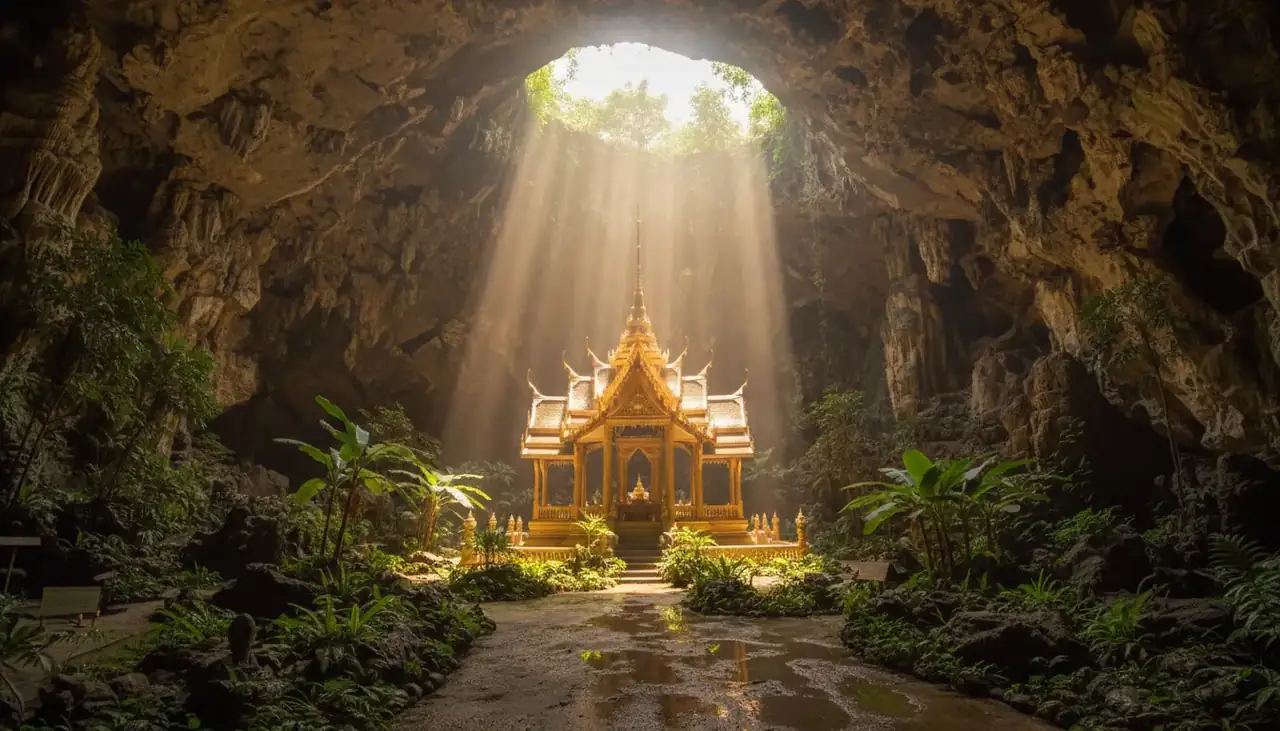
Sam Roi Yot and Phraya Nakhon Cave: the drive south takes around an hour to reach the trailhead parking area. The road quality is good. From the car park at Bang Pu, you either take a short boat ride to Laem Sala Beach or walk the beach path, followed by a steep climb to the cave itself. The driving part is straightforward; the last section is foot-traffic only.
Across all rural routes, watch for: motorbikes appearing from hidden side roads and overtaking on both sides; stray dogs sleeping on warm asphalt; poor lighting after dark; and sudden monsoon downpours that cut visibility to near zero within seconds. The first few minutes of tropical rain are the most dangerous — the road surface becomes extremely slippery before the water clears the oil residue.
Fuel: What to Put in the Tank
The main fuel networks along Phetkasem Road are PTT/OR, Bangchak, Shell, and PT. Several stations on the Highway 4 corridor operate 24 hours, including at least one Shell and PT location in the Hua Hin area. Smaller rural stations typically run 06:00–22:00.
Fuel Prices (Mid-2026 Reference)
| Fuel type | Price (THB/litre) | Notes |
|---|---|---|
| Gasohol 95 (E10) | 41.10 | Standard choice for most rental cars |
| Gasohol 91 (E10) | 40.73 | Acceptable for many economy engines |
| Gasohol E20 | 36.10 | Only use if your rental contract specifies it |
| Diesel B7 | 38.80 | For pickups and diesel SUVs only |
| Diesel B20 | 33.80 | Less common; check if your vehicle accepts it |
The single most important fuelling rule: fill only what the sticker on the fuel cap or the rental agreement specifies. Do not guess based on price. Putting E20 into an engine not rated for it, or putting petrol into a diesel vehicle, is an error the rental company will charge you for — and it is not covered by any standard insurance policy.
Payment at major chain stations accepts cash and most international cards, along with QR-code payment. On rural routes away from the main highway, carry enough cash to cover a full tank — card terminals at smaller stations can be unreliable, and some apply a minimum transaction amount for cashless payment.
Parking in Hua Hin
The most predictable parking in Hua Hin is at the two main malls on Highway 4. BluPort Resort Mall offers free structured parking with no time limit during mall hours. Market Village has multi-storey parking that is typically free, with a nominal hourly fee kicking in during peak weekend days after the first few hours. Market Village introduced a cashless parking system in 2026. Both malls are on Highway 4 and make a convenient base for exploring the town without circling narrow streets.
For the Hua Hin Night Market (Chat Chai/central area), there is no organised car park directly adjacent. Street parking in the area uses an odd/even day system — on odd-numbered calendar dates, parking is permitted on the side of the road signed for odd days; on even dates, it shifts to the opposite side. Kerb markings also signal restrictions: alternating red-and-white blocks mean no stopping at any time; yellow-and-white blocks indicate a loading or bus stop zone. Wheel-clamping is the standard enforcement tool, and removal requires a trip to the local police station. The simplest approach is to park at one of the malls and walk or take a short taxi ride.
Cicada and Tamarind Markets
These weekend evening markets near Khao Takiab have dedicated private parking directly opposite the entrance at around 50 THB per car per evening. The lot holds approximately 200 vehicles, which sounds like a lot until you see weekend demand. If you arrive after 18:30, you are likely to find the lot full and traffic on the access road stacked. Plan to arrive before 18:00 if you are driving.
Nature Sites
Monsoon Valley Vineyard has free on-site parking for visitors. For national park sites like Sam Roi Yot and Kaeng Krachan, expect a vehicle entry fee of around 30 THB in addition to the per-person entry fee (approximately 200 THB for foreign visitors in 2025–2026). At the Phraya Nakhon Cave trailhead, parking is approximately 20 THB — carry small notes for these cash-only points.
If you are also planning the trip from Bangkok by road, our Bangkok to Hua Hin driving guide covers the Highway 4/35 corridor, toll expectations, and timing recommendations.
Seasons, Rain, and Songkran
Hua Hin's green season runs roughly May through mid-October, with September and October being the wettest months. The Thai Meteorological Department declared the 2026 rainy season open on 15 May. Rain in this region does not typically mean grey drizzle all day — it usually means a dry morning followed by a rapid, intense tropical downpour in the afternoon. The danger for drivers is that these downpours are sudden and brief. Visibility drops to almost nothing, and the road surface — particularly in the first three to five minutes of rain — becomes dangerously slick as water lifts accumulated oil residue off the asphalt. Double your following distance before the rain arrives if you see storm clouds building.
The cool season from November to February brings the best weather but also the heaviest tourist traffic. Parking in central Hua Hin tightens up on weekends, and the Highway 4 corridor from Bangkok becomes seriously congested on long holiday weekends. Plan accordingly: avoid travelling the Bangkok–Hua Hin route on Friday evenings or Sunday afternoons during peak season.
Songkran: Thailand's Most Dangerous Road Week
The hot season from March through April adds heat fatigue to the driving challenge. Mid-April brings Songkran — the Thai New Year water festival. This is also when Thailand records its worst road safety statistics of the year. In 2026, the official "seven dangerous days" of Songkran resulted in 242 deaths and 1,242 accidents nationwide. Road safety plans were in place in Hua Hin, but accident rates remain dramatically elevated across all of Thailand during this period.
If you are in Hua Hin during Songkran: keep windows closed (water spraying is traditional and pedestrians step into the road constantly), drive only in daylight if possible, be prepared for drunk or distracted drivers in unusual numbers, and avoid long rural drives after dark. This is not the week to attempt a first-time drive to Pala-U or deep into Kaeng Krachan.
If You Have an Accident: What to Do
The protocol matters here. Thailand's insurance and legal system for road accidents works differently from most Western countries, and the wrong action in the first five minutes can void your entire rental insurance coverage.
Step-by-Step
- Secure the scene first. Move the car off the road only if it is safe to do so, switch on hazard lights, and check for injuries.
- Call emergency services if needed. Ambulance: 1669. Police: 191. Do not skip this step for anything involving injury or significant damage.
- Call your rental company or insurer immediately — before discussing fault with the other party. Thai rental insurers typically send a surveyor to the scene who acts as the official accident arbiter. Do not attempt to negotiate a private settlement on the roadside; doing so invalidates most rental insurance policies.
- Do not admit fault verbally or sign anything you cannot read. Even a polite apology in English can be interpreted as an admission of liability under local practice.
- Document everything before anyone moves. Photograph both vehicles from multiple angles, the road position, skid marks, licence plates, and the driving licences of other parties. Take these photos before any vehicle is moved.
- Get a police report. For insurance claims — and certainly for anything involving injury — you need an official police report number. The rental company will require it.
Emergency Numbers
| Number | Service |
|---|---|
| 191 | Police — general emergency |
| 1669 | Ambulance and medical emergency (national) |
| 1155 | Tourist Police — English-speaking, 24/7, first call for tourist disputes |
| 1193 | Highway Police — for incidents on major intercity roads |
| 1586 | Highway hotline |
The Tourist Police line (1155) is specifically staffed to handle situations involving foreign visitors and can provide translation assistance. If there is any ambiguity about fault, or if the other party becomes aggressive, contact them rather than trying to resolve the situation alone.
If you are also planning a day trip south, see our Cha Am car rental guide for what to expect on that stretch of Highway 4.
Frequently Asked Questions
Is driving in Hua Hin safe for tourists?
Do I need an International Driving Permit?
Is it hard to adjust to driving on the left?
Do I need a 4WD or SUV in Hua Hin?
Ready to compare car rental deals in Hua Hin?
Check live prices and availability from local and international suppliers.
Compare car rental deals